Kitchen Remodeling in Monmouth County, NJ
Kitchen remodeling in Monmouth County, NJ covers a wide range of houses: homes built before the Second World War, postwar and 1970s neighborhoods, and properties near the shore and the rivers where flood maps can come into play. The same kitchen plan can be a straightforward cabinet replacement in one of those houses and a permit project with extra paperwork in another.
MG Builders is a New Jersey remodeling contractor, in business since 1997, with its office at 130 Plainfield Ave in Edison. This page covers what Monmouth County homeowners tend to ask before a kitchen project: how the age of the house affects the work, when flood hazard rules apply, which projects need the town's construction office, and how to plan an opened-up layout. The photos and quotes below come from MG customers' own Google reviews.
By MG Builders · Updated
How Old Are Monmouth County Homes, and Why Does It Matter in the Kitchen?
Older than many people assume, and the age shows most in the rooms that carry the most plumbing and power. The U.S. Census Bureau's 2024 American Community Survey counts 271,940 housing units in Monmouth County. 56.1% of them were built before 1980, and 14.2%, roughly one home in seven, were built in 1939 or earlier. The median year built is 1975.
That prewar share is the part that sets the county apart for kitchen work. A house built before 1940 was designed around an icebox or an early refrigerator, a single range and very few outlets. By now it has usually been updated several times, and each update was fitted into whatever the last one left behind. Walls may be plaster on lath rather than drywall, floors may not be level, and the kitchen may sit on framing that has been notched or patched for decades of pipe and wire changes.
Newer homes carry their own questions. A kitchen from the 1970s or 1980s is often due for its first full replacement, and the original layout, soffits and lighting are frequently still in place. In both cases, the useful approach is the same: expect the walls and floor to tell you something once the cabinets are out, and agree in advance how those findings will be handled.
Do Flood Hazard Rules Affect a Kitchen Remodel Near the Monmouth County Coast?
They can, and it is worth checking before the design is settled rather than after. Monmouth County has a long Atlantic and bay shoreline plus tidal rivers, and some properties there sit in mapped flood hazard areas. Whether a particular house does is a question for the flood map and the local floodplain administrator, not for a general guide, and nothing on this page should be read as saying any town is or is not in a flood zone.
Here is why it matters for a kitchen. Under N.J.A.C. 5:23-6.3A, when a building is in a flood hazard area and the cost of work on it reaches 50% or more of the structure's market value, the project is a "substantial improvement." The local floodplain administrator makes that determination, and a substantially improved building has to meet the code's flood-resistant construction requirements. A kitchen on its own may not reach that threshold, but a kitchen combined with bathrooms, flooring and new systems in the same project can bring the total much closer.
The practical steps are simple. Look the address up on FEMA's Flood Map Service Center. If the house is in or near a mapped flood hazard area, raise it with the contractor at the first meeting, and expect the construction office to ask how the value of the work compares with the value of the structure. For additions and substantial improvements in these areas, 5:23-2.18 also requires elevation documentation before vertical construction continues.
For houses outside mapped areas, the flood rules do not change the project, but moisture still deserves attention in any kitchen: a leak under a sink or behind a dishwasher is easiest to catch and fix while the cabinets are out.
Sources: N.J.A.C. 5:23-6.3A (flood hazard areas); FEMA Flood Map Service Center; N.J.A.C. 5:23-2.18 (inspections)
Which Parts of a Monmouth County Kitchen Job Go Through the Construction Office?
Only the parts that change the house's structure or systems. Monmouth County's government does not issue building permits; each of the 53 municipalities MG serves in the county, from Marlboro and Manalapan to Middletown, Freehold Township and Wall Township, is served by a local construction office enforcing the statewide Uniform Construction Code. The state Department of Community Affairs lists those offices.
The code's ordinary maintenance list in N.J.A.C. 5:23-2.7 covers much of a kitchen refresh in a one- or two-family home. These items need no permit, no notice and no inspection:
- installing cabinets and laying new flooring
- painting and new trim
- patching or replacing drywall or plaster on less than a quarter of the wall area
- replacing a faucet, or replacing a fixture where the piping stays as it is
- insulation other than foam plastic
Sources: N.J.A.C. 5:23-2.7 (ordinary maintenance); N.J.A.C. 5:23-2.17A (minor work); N.J.A.C. 5:23-2.16 (permit review); NJ Department of Community Affairs: local construction offices
When Does a Kitchen Plan Need Notice or a Permit Instead?
As soon as it adds or relocates piping, runs most kinds of new wiring, or cuts into a load-bearing wall or beam. Those items are specifically excluded from ordinary maintenance, so a kitchen that gets a relocated sink, a new range circuit, recessed lighting on a new circuit or a wider opening to the family room is outside the no-permit category.
Some of that work is minor work under N.J.A.C. 5:23-2.17A, the category for renovations in an existing one- or two-family home that alter no primary structural members. It can start once notice is given to the construction office, the permit application follows within five business days, and the office must perform a requested inspection within three business days. Work that alters structure goes the full permit route; N.J.A.C. 5:23-2.16 then gives the construction official 20 business days to approve or deny the application unless the applicant agrees to more time.
In an older Monmouth County house, gutting a kitchen can push past the ordinary maintenance limit on its own. Replacing plaster on a quarter or more of the wall area is not on that list, and in a prewar kitchen much of the plaster can come down once the cabinets, soffits and old wiring are removed. A contractor should say which category each part of the project falls into and who is filing.
Plumbing, electrical and HVAC work must be done by contractors licensed in those trades (a homeowner working on their own single-family home is the exception), and the home improvement contractor's state registration number goes on the permit application. MG Builders' registration number is 13VH08376600.
Sources: N.J.A.C. 5:23-2.17A (minor work); N.J.A.C. 5:23-2.16 (permit review); N.J.A.C. 5:23-2.15 (permit applications)
Can You Turn a Closed Monmouth County Kitchen Into an Open Layout?
In many houses, yes, and two of the reviews quoted on this page describe exactly that kind of work: one a full kitchen renovation into an open-concept layout, the other major work with walls coming down and beams put up.
What decides the difficulty is the wall itself. A partition that only divides rooms can come out once whatever runs through it is moved. A wall that supports joists or rafters above has to be replaced by a beam, and the load that beam collects has to travel down through posts to adequate support below, sometimes to new footings in the basement or crawlspace. Taking out a load-bearing wall or a beam is excluded from ordinary maintenance, so it is always permit work, and plans for it are generally sealed by a registered architect or licensed engineer under N.J.A.C. 5:23-2.15.
Older houses add a few specific checks. Some houses from before the 1940s are balloon-framed, with wall studs that run from the sill up past the second floor, which changes how an opening is framed. Heating pipes, gas lines and chimney flues sometimes run through the very wall a homeowner wants to remove. And once a wall is gone, the floors on each side may not line up, so the new flooring plan should account for leveling where the two rooms meet.
The inspections follow the work. For one- and two-family homes, the code's list includes a mid-point inspection of framing after rough plumbing, electrical and ducts are in, and of insulation before the walls are finished, followed by a final inspection when the kitchen is complete.
Sources: N.J.A.C. 5:23-2.7 (ordinary maintenance); N.J.A.C. 5:23-2.15 (permit applications); N.J.A.C. 5:23-2.18 (inspections)
What Should Be Decided Before the Old Kitchen Comes Out?
Nearly everything that ends up inside a wall, and anything with a long lead time. Changing your mind about a sink location after the plumbing is roughed in, or about an appliance after the cabinets are ordered, is where kitchen projects lose time. A good plan settles these items first:
- Appliance models, with their specification sheets, since they set cabinet openings, electrical and gas connections, and how the range hood is ducted.
- Sink, dishwasher and refrigerator locations, including whether the refrigerator needs a water line.
- The lighting plan: recessed, pendant, under-cabinet, and which switches control what.
- Outlet locations along the counters and on any island or peninsula.
- Cabinet style, construction and layout, plus details such as glass-front uppers, pantry units or a wall oven stack.
- Countertop material and edge, which is templated after the base cabinets are installed.
- Flooring, and whether it runs under the cabinets or stops at them, especially where an opened wall joins two rooms.
- Backsplash tile and how far it runs, including behind the range hood.
What Should Owners of Pre-1978 Monmouth County Homes Know About Lead Paint?
That kitchen demolition disturbs a lot of painted surface. Old cabinets are pried off painted walls, soffits come down, window and door trim is removed and walls are opened for new wiring. With more than half of Monmouth County's homes built before 1980, many kitchens in the county are in houses where lead-based paint may be present under later coats.
Under the EPA's Renovation, Repair and Painting Rule, contractors paid to disturb painted surfaces in homes built before 1978 must be certified by the EPA and follow lead-safe work practices. Homeowners can ask any contractor for its EPA firm certification before that work begins.
The EPA's rule also sets out work practices for that kind of job, such as containing the work area and cleaning up with methods that keep dust from spreading. Before demolition, ask any contractor how it will handle painted surfaces in your home and whether the proposal reflects that.
Sources: EPA Renovation, Repair and Painting Program; U.S. Census Bureau, 2024 American Community Survey 1-year estimates, tables B25034 and B25035 (via Census Reporter)
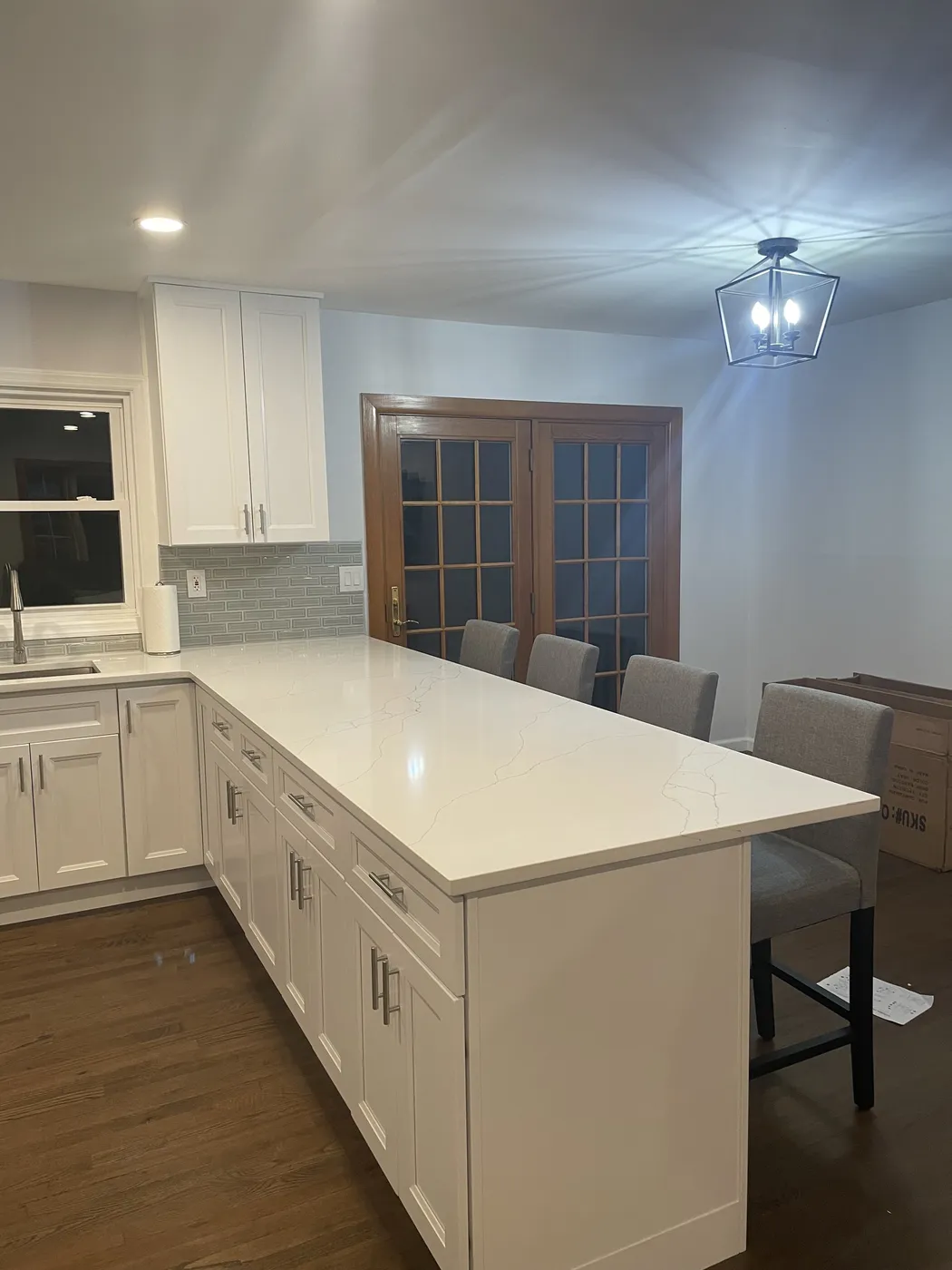
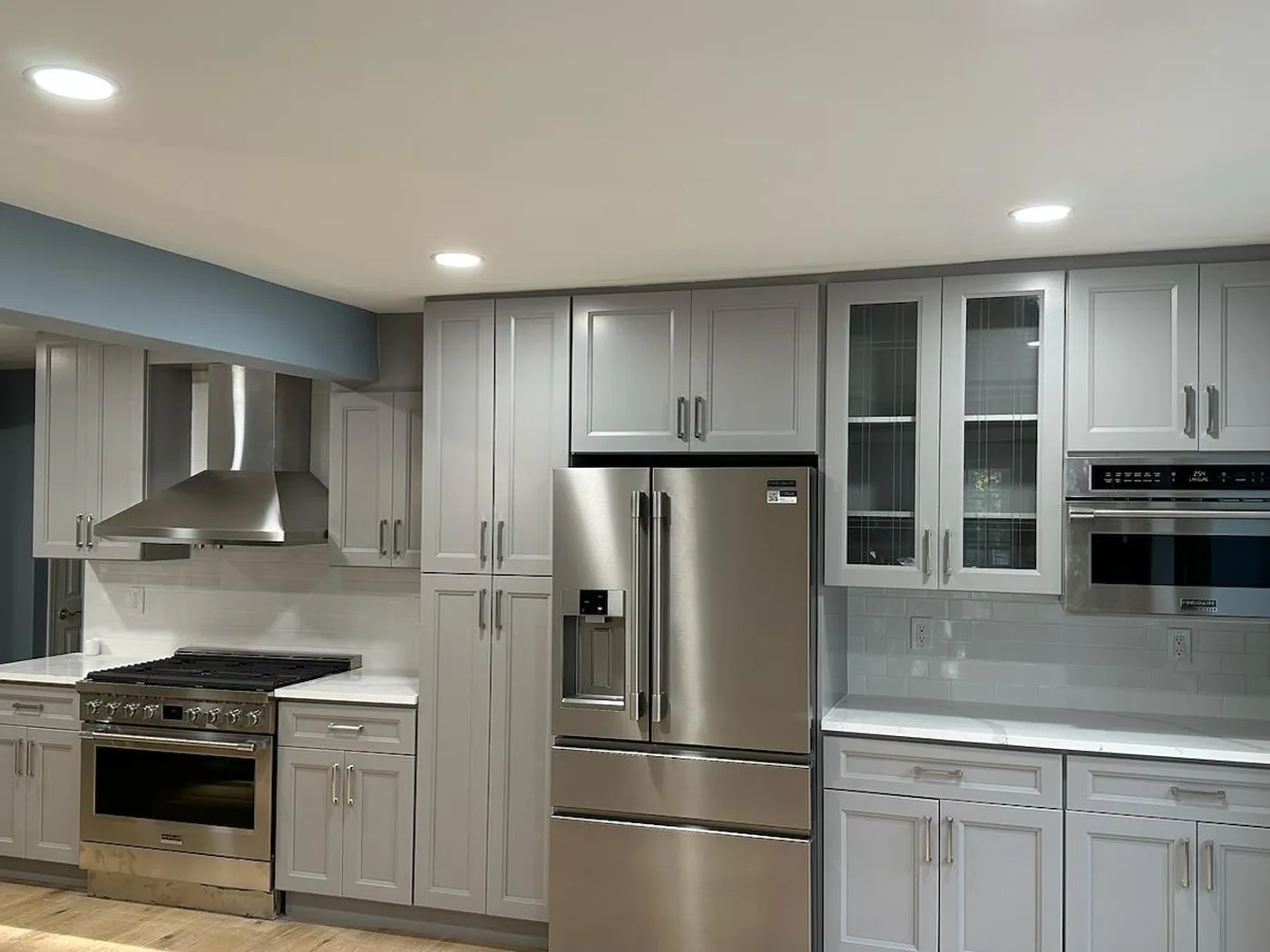
Kitchens Remodeled by MG Builders, as Shared in Google Reviews
The customers who posted these photos with their Google reviews did not name a town, so this page does not claim a location for either kitchen.
What Homeowners Say in Their Google Reviews
The quotes below are taken word for word from Google reviews that mention kitchen work by MG Builders. An ellipsis marks each place where a review was shortened. MG Builders is rated 4.8 across 90+ Google reviews. Read every review on Google.
“We used MG Builders recently for our kitchen and basement renovations. We love the work done. We had major work done with walls coming down and beams put up.”
“Unlike the previous contractors who just wanted to recreate the same boring thing we had before, Giovanni listened to what we actually wanted and had suggestions and creative solutions. … As with any project unexpected things came up and when they did, Giovanni put in the effort to solve them.”
“The project included a brand new HVAC system, a full kitchen renovation into an open-concept layout, and beautifully updated bathrooms that are not only modern but also much more functional—especially for older individuals. … Everything was also updated to meet current code, which gave us great peace of mind.”
“MG Builders remodeled my kitchen and 2 bathrooms from A to Z, we are very happy with the results and recommend their work”
Kitchen Remodeling in Monmouth County: Frequently Asked Questions
How do I plan kitchen remodeling in Monmouth County, NJ?
Start with how you want the kitchen to work, then find out what the house allows. Check the home's construction year, look the address up on FEMA's flood map if you are near the water, and decide early whether any walls, the sink or major appliances will move, since those choices decide whether the job needs notice or a permit from your town. Then get a written proposal that lists the scope, the selections and who files with the construction office.
Does Monmouth County issue building permits for kitchens?
No. The county government does not issue building permits. Each municipality is served by a local construction office, so a kitchen in Holmdel, Howell, Long Branch or Red Bank goes through the office for that town under the same statewide Uniform Construction Code. MG Builders works in the 53 Monmouth County towns listed on this site.
My house may be in a flood zone. Does that change my kitchen remodel?
Possibly. Under N.J.A.C. 5:23-6.3A, if the house is in a flood hazard area and the work costs 50% or more of the structure's market value, the local floodplain administrator treats it as a substantial improvement, and the building then has to meet flood-resistant construction rules. Check FEMA's Flood Map Service Center for your address and raise the question with your contractor before the scope is final.
Is new cabinetry and flooring ordinary maintenance?
In a one- or two-family home, yes. N.J.A.C. 5:23-2.7 lists installing cabinets and flooring, painting and trim among ordinary maintenance, which needs no permit, notice or inspection. The same list covers a faucet swap or a fixture replacement that leaves the piping as it is.
Is plaster in an older kitchen a problem?
Not a problem, but a factor. Plaster walls take more care to open for new wiring or piping, and they may hide older wiring or patched framing. Under the state code, replacing interior finishes on less than 25% of the wall area is ordinary maintenance; a gut that replaces more than that, or that adds wiring and piping, goes through the town's construction office.
Can a load-bearing wall come out to open my kitchen to the family room?
Usually it can, with a beam and posts designed to carry the load the wall supported. Cutting or removing a load-bearing wall is never ordinary maintenance, so it needs a permit, and the construction documents are normally sealed by a registered architect or licensed engineer. The town inspects the framing before the walls are closed.
What affects the cost of a kitchen remodel in Monmouth County?
Main factors include the size of the kitchen; whether walls, the sink or the range move; beam work for an opened layout; the condition of older wiring, piping, plaster and framing; cabinet line and finish; countertops and backsplash; appliances and hood ducting; flooring; flood hazard requirements where they apply; and the permits and inspections the scope needs. MG Builders gives a free estimate after seeing the kitchen.
Does MG Builders work on kitchens in my Monmouth County town?
MG Builders serves the 53 Monmouth County towns listed on this site, including Marlboro, Manalapan, Holmdel, Middletown and Freehold. Call (732) 636-3000 to confirm availability for your address.
Monmouth County Towns We Serve
MG Builders serves these 53 Monmouth Countytowns. Permits come from the construction office that serves the property’s municipality.
- Marlboro, NJ
- Manalapan, NJ
- Holmdel, NJ
- Aberdeen, NJ
- Matawan, NJ
- Middletown, NJ
- Red Bank, NJ
- Long Branch, NJ
- Freehold, NJ
- Freehold Township, NJ
- Howell, NJ
- Tinton Falls, NJ
- Eatontown, NJ
- Shrewsbury, NJ
- Rumson, NJ
- Fair Haven, NJ
- Little Silver, NJ
- Oceanport, NJ
- West Long Branch, NJ
- Keyport, NJ
- Union Beach, NJ
- Hazlet, NJ
- Keansburg, NJ
- Atlantic Highlands, NJ
- Highlands, NJ
- Sea Bright, NJ
- Monmouth Beach, NJ
- Deal, NJ
- Asbury Park, NJ
- Neptune, NJ
- Neptune City, NJ
- Bradley Beach, NJ
- Avon-by-the-Sea, NJ
- Belmar, NJ
- Spring Lake, NJ
- Spring Lake Heights, NJ
- Wall Township, NJ
- Manasquan, NJ
- Brielle, NJ
- Sea Girt, NJ
- Colts Neck, NJ
- Farmingdale, NJ
- Englishtown, NJ
- Morganville, NJ
- Millstone, NJ
- Roosevelt, NJ
- Upper Freehold, NJ
- Allentown, NJ
- Lake Como, NJ
- South Belmar, NJ
- Ocean Township, NJ
- Loch Arbour, NJ
- Interlaken, NJ
Kitchen Remodeling with MG Builders →
The full service overview.
Remodeling in Monmouth County →
Every service MG offers in the county.
Bathroom Remodeling in Monmouth County→
Code tiers, flood-area rules, moisture control and older-plumbing questions for a Monmouth County bathroom remodel.
Basement Finishing in Monmouth County→
Water control, radon testing, flood-area rules and town permits for a Monmouth County basement.
Home Additions in Monmouth County→
Lot limits, flood-map checks, sealed plans and town inspections for adding space to a Monmouth County house.
Kitchen Remodeling in Middlesex County→
Permits, opening walls, older-home wiring and plumbing, and the questions to ask kitchen contractors in Middlesex County.
Thinking About a Kitchen Remodel in Monmouth County?
Call for a free estimate. If you would like to visit our Edison office, call ahead to confirm availability.
(732) 636-3000