Bathroom Remodeling in Monmouth County, NJ
If you are planning a bathroom remodel in Monmouth County, NJ, the finishes you pick are only part of the job. Behind a new vanity and a tiled shower sit supply lines, a drain, a vent stack, an exhaust duct and a circuit or two, and in a county where most homes date from before 1980, those hidden parts are often the original ones.
MG Builders, a New Jersey remodeling contractor since 1997 with its office at 130 Plainfield Ave in Edison, wrote this page for homeowners from Marlboro and Holmdel to Red Bank and Wall Township. It covers housing age, the state code's three tiers for bathroom work, flood hazard rules near the shore, and keeping a new shower dry. The photos and quotes come from MG customers' Google reviews.
By MG Builders · Updated
How Old Are the Bathrooms in Monmouth County Homes?
Old enough that many of them have already been redone once, over plumbing that was never replaced. The U.S. Census Bureau's 2024 American Community Survey counts 271,940 housing units in Monmouth County. 56.1% of them were built before 1980, and the county's median year built is 1975.
The county also holds a larger share of very old homes than its neighbor to the north: 14.2% of Monmouth's housing units were built in 1939 or earlier, against 10.3% in Middlesex County. Prewar houses near the older downtowns and along the coast can hide decades of layered repairs, and a bathroom is usually where those layers meet.
For a remodel, the age of the house tells you where to look before the demolition crew arrives. A second-floor bathroom added years after construction may drain through a long, shallow run, and a fan may be ducted into the attic instead of outside. None of that can be confirmed from the doorway, which is why a careful estimate names the conditions that could change the scope once the walls are open.
That 1975 median also falls just before 1978, the EPA lead-paint rule's cutoff, covered below.
Does a Flood Hazard Area Change a Monmouth County Bathroom Project?
It can, and with the county's long Atlantic and bayshore coastline plus its rivers, it is worth checking before the design is final. The first step is simple: look up the property on FEMA's Flood Map Service Center, or ask the town's construction office, to learn whether the house sits in a mapped flood hazard area. Whether a given property is in one depends on its exact location, not on the town's name.
If the house is in a flood hazard area, New Jersey's rule in N.J.A.C. 5:23-6.3A looks at the size of the work compared with the building. When the cost of an improvement equals or exceeds 50% of the structure's market value, it counts as a "substantial improvement," and the work must then meet the code's flood-resistant construction requirements. The local floodplain administrator makes that determination, not the contractor or the homeowner.
A bathroom alone rarely nears half a house's value, but it is often one part of a larger renovation, and the administrator weighs the whole project. Raising the flood question at the start avoids redesigning a finished plan.
Sources: FEMA Flood Map Service Center; N.J.A.C. 5:23-6.3A (flood hazard areas)
Which Office Reviews a Bathroom Remodel in Monmouth County?
The construction office of the municipality where the house stands. Monmouth County government does not issue building permits, so a bathroom in Freehold Township is reviewed by Freehold Township's construction office, one in Long Branch by Long Branch's, and so on across the county's towns.
All of them enforce the same statewide Uniform Construction Code; what varies is how notices are submitted, local fees and inspection booking. The NJ Department of Community Affairs keeps a directory of local construction offices.
When a permit is required, the construction official must approve or deny the application within 20 business days under N.J.A.C. 5:23-2.16, unless the applicant agrees to extend that window. Work that qualifies as minor work follows a faster track, explained in the next section.
Plumbing, electrical and HVAC work must be done by contractors licensed in those trades (a homeowner working on their own single-family home is the exception), and the home improvement contractor's state registration number goes on the permit application. MG Builders' registration number is 13VH08376600.
Sources: NJ Department of Community Affairs: local construction offices; N.J.A.C. 5:23-2.16 (permit review); N.J.A.C. 5:23-2.15 (permit applications)
Is Your Bathroom Project Ordinary Maintenance, Minor Work or Permit Work?
New Jersey's code sorts home projects into tiers, and one bathroom can land in any of them depending on what changes. The tier decides whether the town hears about the job and how soon work can start.
Minor work, defined in N.J.A.C. 5:23-2.17A, is renovation in an existing one- or two-family home that does not alter primary structural members. It starts on notice: the contractor or owner notifies the construction office, work can begin, and the permit application follows within five business days of that notice. Inspections for minor work are performed within three business days of a request. Adding fixtures inside the existing space also counts as minor work, as long as the water distribution system, water service and house drain do not need to get bigger.
| Bathroom task | Where it usually falls |
|---|---|
| Painting, new flooring, a new vanity cabinet, new trim | Ordinary maintenance (N.J.A.C. 5:23-2.7): no permit, notice or inspection |
| Swapping a toilet, sink, faucet or shower valve for a similar one without changing the piping | Ordinary maintenance |
| New drywall or plaster on less than a quarter of the wall area | Ordinary maintenance |
| Moving a toilet, relocating a drain or adding piping | Outside ordinary maintenance: minor work or a plumbing permit, depending on the system |
| Adding a shower or second sink in existing space, no larger water or drain lines needed | Minor work (N.J.A.C. 5:23-2.17A) |
| New circuits or most new wiring for lights, a heated floor or outlets | Outside ordinary maintenance: needs notice or a permit |
| Removing or cutting a load-bearing wall to enlarge the room | Permit work, reviewed before it starts |
Sources: N.J.A.C. 5:23-2.7 (ordinary maintenance); N.J.A.C. 5:23-2.17A (minor work)
How Do You Keep a New Shower Dry for the Long Run?
Water control is built in layers that disappear behind the tile. Grout is not a barrier; water eventually passes through it, so what matters is what sits behind and beneath.
A well-built shower has a continuous waterproof layer over the walls and the floor pan, carried well up the walls and lapped correctly at every seam, corner and drain connection. Niches and benches are the weak spots, since each one adds inside corners and a sloped surface that has to shed water back into the shower. The floor needs a consistent slope to the drain, and the curb or the edge of a curbless entry needs a detail that keeps water on the right side of the glass.
Air moisture is the other half. The EPA says the key to controlling mold is controlling moisture, and it recommends drying water-damaged areas within 24 to 48 hours. In a bathroom that means an exhaust fan that actually reaches the outdoors and gets used during and after every shower. A fan that dumps humid air into an attic or a closed ceiling cavity only moves the problem somewhere harder to see.
What Turns Up When an Older Monmouth County Bathroom Is Opened?
Usually old piping, tired framing and past shortcuts. With one in seven Monmouth County homes built in 1939 or earlier, and more than half of all of them built before 1980, a remodel is often the first time in decades anyone has seen inside these walls.
Common finds include galvanized or mixed-material supply lines, cast-iron drains that have narrowed inside, subfloor softened by a slow leak at the toilet or tub, joists notched long ago to make room for a drain, and wiring that was extended rather than replaced. Water damage deserves particular attention: the EPA's guidance on mold comes back to moisture, and wet framing or subfloor should be dried or replaced rather than covered up.
Under the EPA's Renovation, Repair and Painting Rule, contractors paid to disturb painted surfaces in homes built before 1978 must be certified by the EPA and follow lead-safe work practices. Homeowners can ask any contractor for its EPA firm certification before that work begins. That rule matters in a bathroom because demolition disturbs painted walls, ceilings, trim and door frames all at once.
The proposal should say how findings are photographed and explained, and that no extra work proceeds until the homeowner approves it in writing.
Sources: EPA Renovation, Repair and Painting Program; EPA: A Brief Guide to Mold, Moisture and Your Home
What Are the Steps of a Bathroom Remodel with MG Builders?
The sequence below is how a bathroom moves from first visit to final walkthrough. How long each step takes depends on the scope, the selections and the town's inspection schedule.
- 1
Walkthrough and measurements
The team looks at the room, the floor below and, where possible, the plumbing and wiring that serve it, and hears what the household wants.
- 2
Layout and selections
Fixture locations are settled first, because they decide the piping. Tile, vanity, glass, lighting and fixtures are chosen next, with help from MG's showroom team.
- 3
Written proposal
The proposal lists the scope, the included materials, who handles notice or permits with the town, and how hidden conditions will be documented and approved.
- 4
Protection and demolition
The work area is sealed off from the rest of the house to limit dust, and the room is taken down to the level the scope calls for.
- 5
Rough work and inspections
Plumbing, wiring, framing repairs and ventilation are completed and, where the job is under notice or permit, inspected before anything is closed in.
- 6
Waterproofing, tile and finish
The shower is waterproofed and sloped, walls are finished, and tile, vanity, fixtures, glass and accessories go in.
- 7
Final inspection and walkthrough
The town's final inspection closes out any notice or permit, and the homeowner walks the finished room with the team to confirm every item on the proposal.
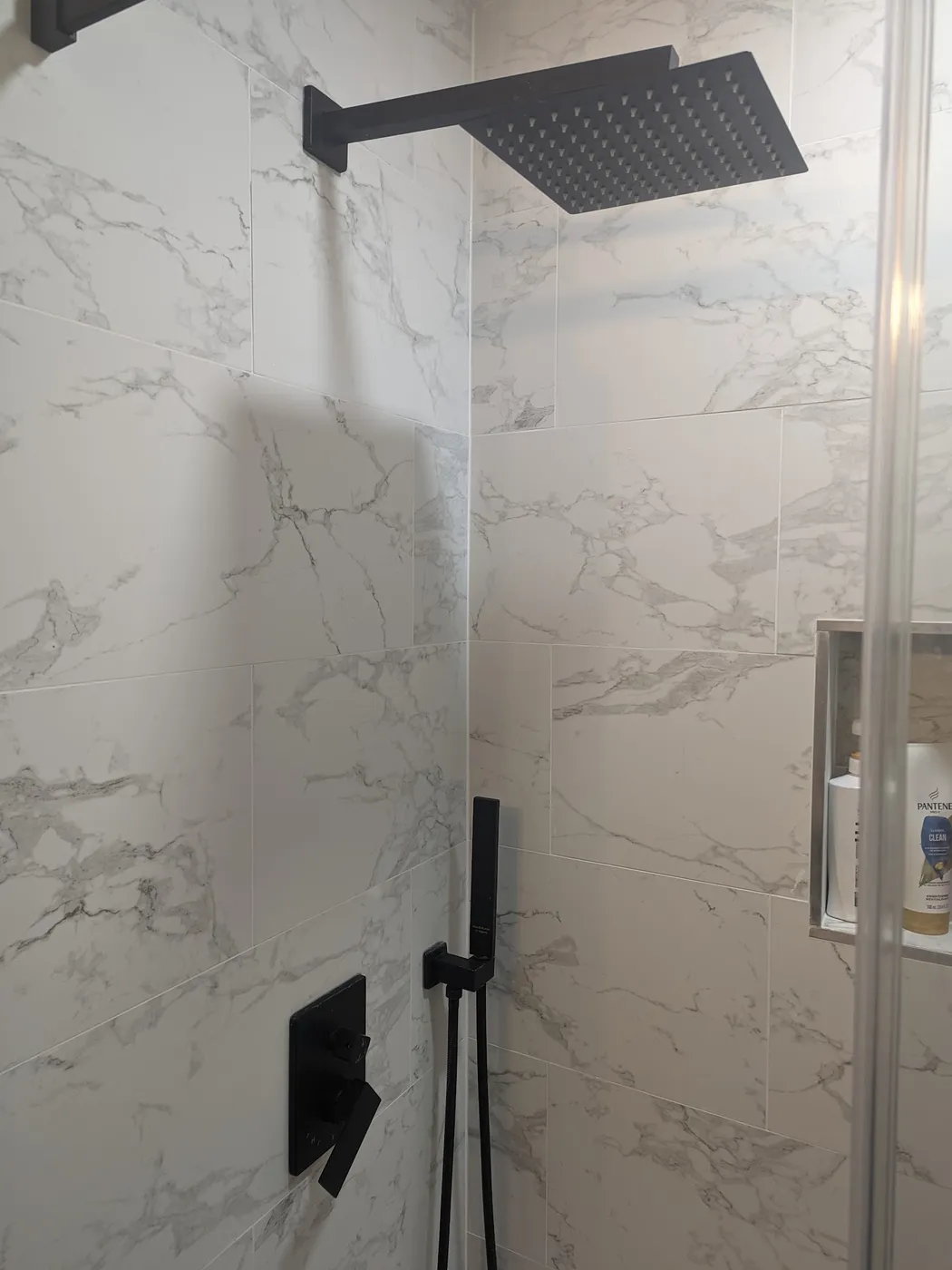
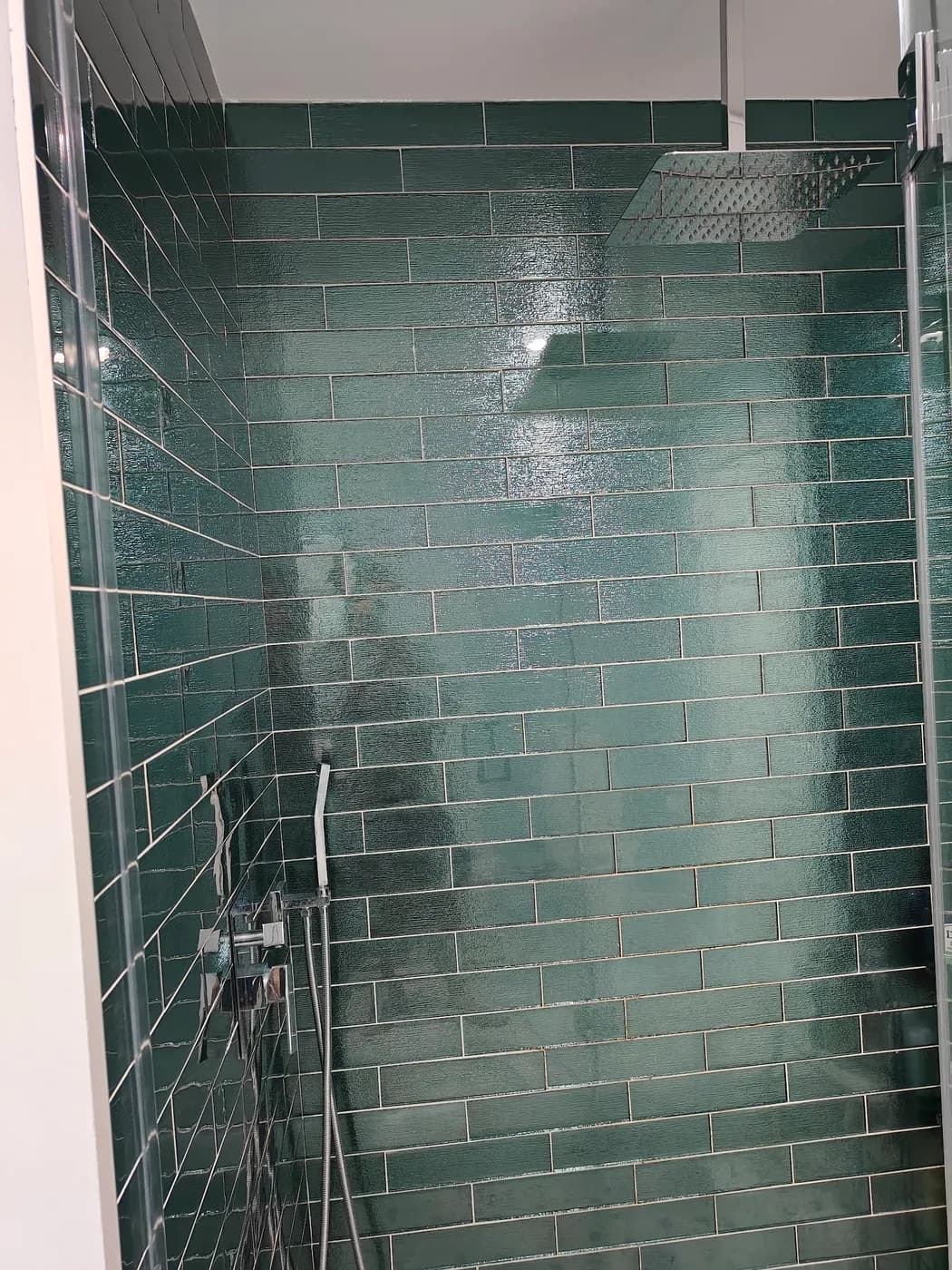
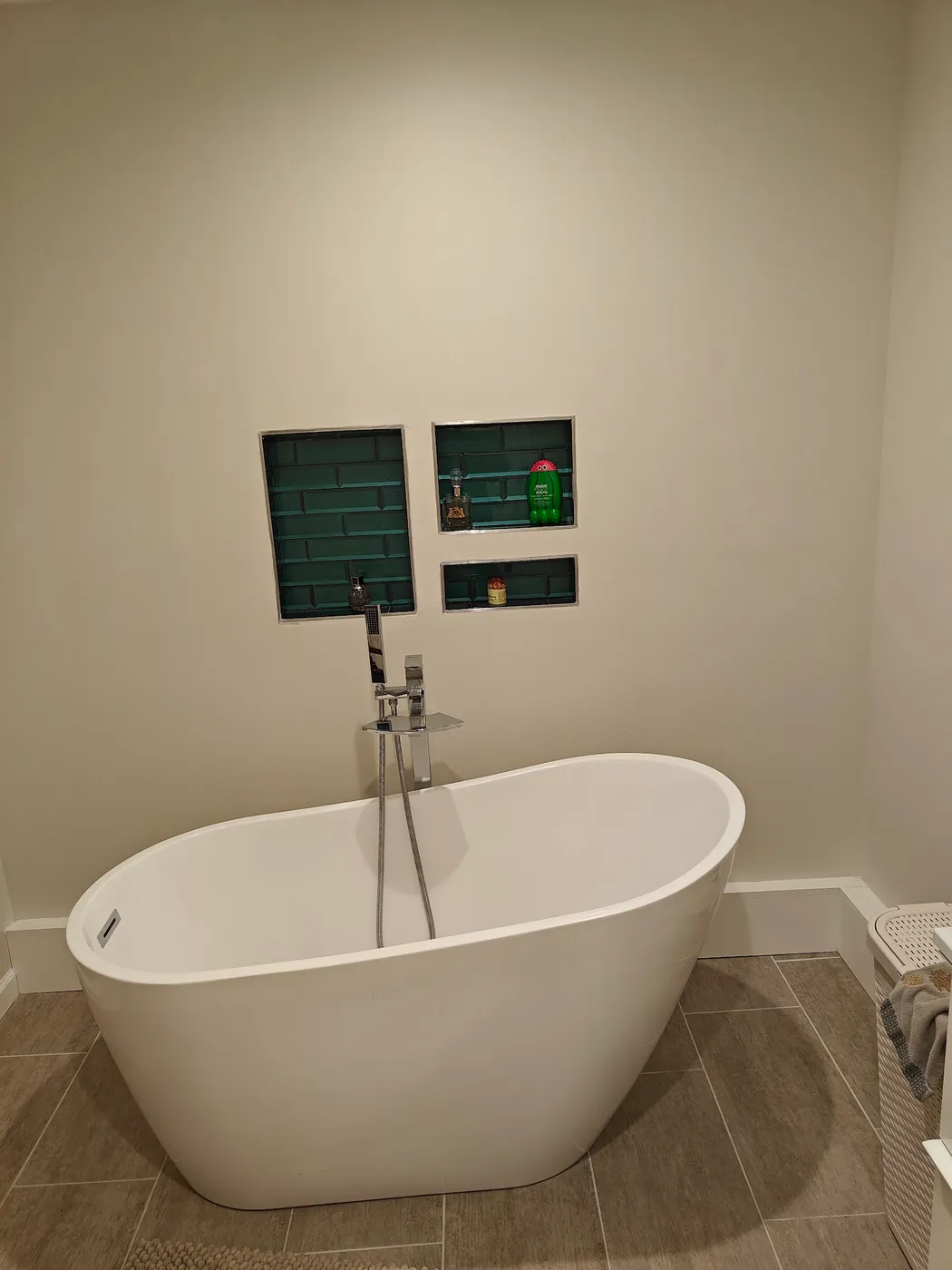
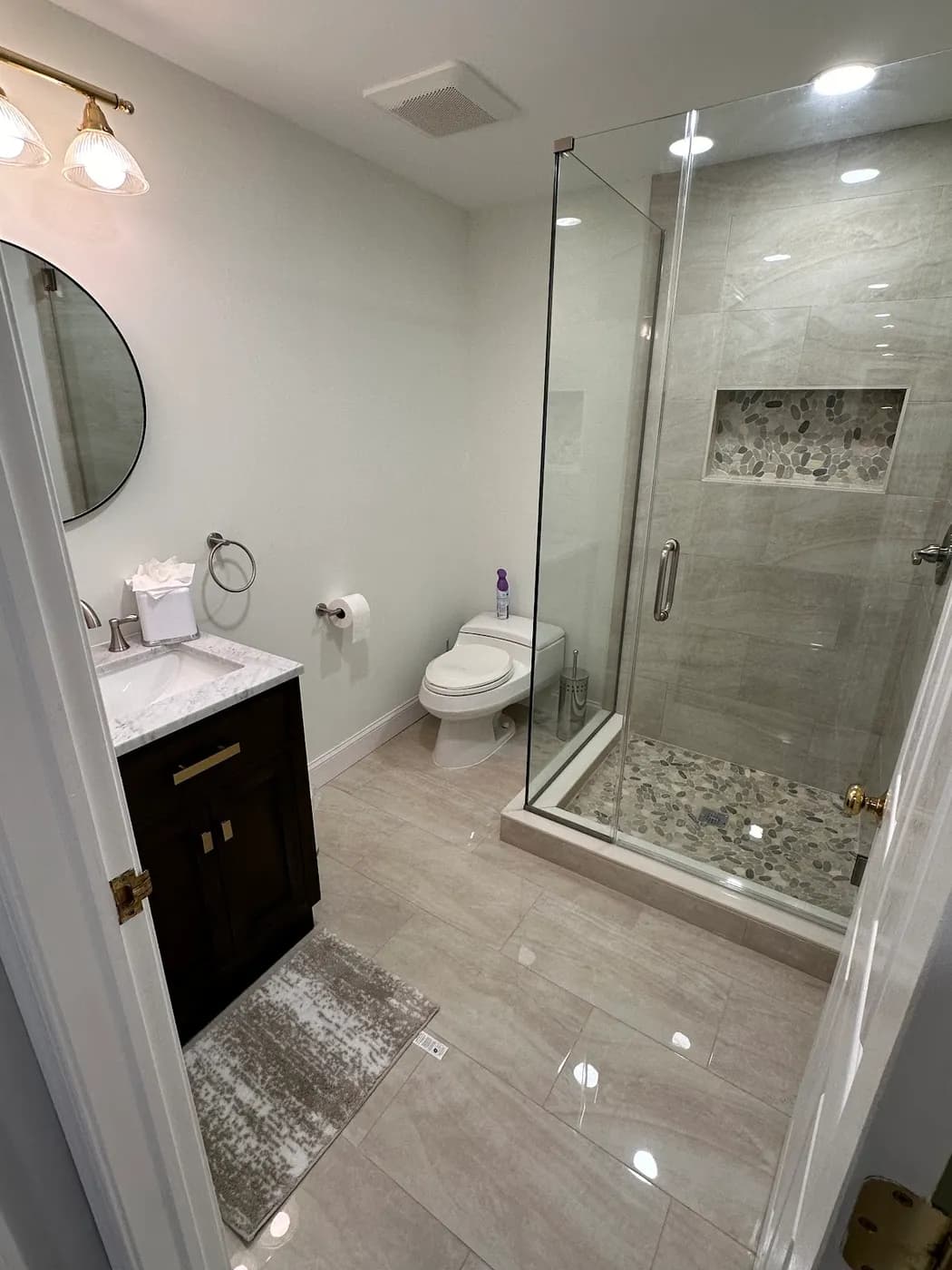
Bathrooms MG Builders Remodeled, from Customers' Google Reviews
Each photo below was posted by an MG customer alongside a Google review. None of those reviews name a town, so no location is claimed for any of these bathrooms.
What Homeowners Say in Their Google Reviews
These excerpts are copied word for word from customers' Google reviews that mention bathroom work, shortened only where an ellipsis appears. MG Builders is rated 4.8 across 90+ Google reviews. Read every review on Google.
“Recently a pipe burst in our master bathroom and since we were going to have contractors in anyway to fix that, we decided to just do the rest of the renovations we had been putting off. … Giovanni listened to what we actually wanted and had suggestions and creative solutions. … As with any project unexpected things came up and when they did, Giovanni put in the effort to solve them.”
“We just had our bathroom done with MG Builders. They did a beautiful job. Every day they were here, they left the place spotless. Communication was great and the workmanship is stellar. I highly recommend them!”
“I recently had my bathrooms done and I couldn’t be happier with how they look and function. … They were courteous, extremely professional, very thorough with explaining the process, & made sure to clean up properly at the end of each day!”
“Originally we used MG builders to redo our kitchen in 2021. they did such a great job, that the following year we reached out to them to get our bathrooms redone and replace old flooring as well”
Bathroom Remodeling in Monmouth County: Frequently Asked Questions
How do I find a bathroom remodel contractor in Monmouth County, NJ?
Start with the paperwork a contractor should be able to show: a New Jersey home improvement contractor registration number, the license numbers of the plumbers and electricians who will do the trade work, and a written proposal that spells out the scope, the included materials and who deals with the town. Then read reviews that describe bathroom work.
Does every bathroom remodel in Monmouth County need a permit?
No. Painting, new flooring, a new vanity cabinet, trim, and replacing a fixture, faucet or shower valve with a similar one when the piping stays the same are all ordinary maintenance under N.J.A.C. 5:23-2.7, with no permit, notice or inspection. Moving fixtures, adding piping, most new wiring and structural changes need either minor-work notice or a permit from the municipal construction office.
Is my Monmouth County house in a flood zone, and does it matter for a bathroom?
Check the address on FEMA's Flood Map Service Center or ask your town's construction office; it depends on the property's exact location. If the house is in a flood hazard area and the total improvement reaches 50% or more of the structure's market value, N.J.A.C. 5:23-6.3A treats it as a substantial improvement that must meet flood-resistant construction rules. The local floodplain administrator decides whether that threshold is met.
Can a tub be replaced with a walk-in shower?
Usually, though it is more than a swap. A walk-in shower needs its own waterproofing on the walls and floor, a floor sloped to the drain, often a relocated or resized drain, and a new valve location. Because the piping changes, the work falls outside ordinary maintenance, and the town's construction office will need notice or a permit application first.
Do lead-paint rules apply to bathroom work in an older Monmouth County home?
If the house was built before 1978, yes. The EPA's Renovation, Repair and Painting Rule requires anyone paid to disturb painted surfaces in those homes to be certified and to follow lead-safe work practices. Monmouth County's median home was built in 1975, so check your home's year and ask any contractor for its EPA firm certification before demolition.
What affects the cost of a bathroom remodel in Monmouth County?
The biggest factors are the size of the room; whether fixtures stay in place or move; what the old piping, subfloor and wiring look like once exposed; the shower or tub type and the glass; tile, vanity and fixture selections; exhaust and electrical upgrades; and any notice, permits and inspections the town requires. MG Builders gives a free estimate after seeing the bathroom in person.
Does MG Builders work in my Monmouth County town?
MG Builders serves the 53 Monmouth County communities listed on this page, from Marlboro, Manalapan and Holmdel to Middletown, Freehold and Howell. Call (732) 636-3000 to confirm availability for your address.
Monmouth County Towns We Serve
MG Builders serves these 53 Monmouth Countytowns. Permits come from the construction office that serves the property’s municipality.
- Marlboro, NJ
- Manalapan, NJ
- Holmdel, NJ
- Aberdeen, NJ
- Matawan, NJ
- Middletown, NJ
- Red Bank, NJ
- Long Branch, NJ
- Freehold, NJ
- Freehold Township, NJ
- Howell, NJ
- Tinton Falls, NJ
- Eatontown, NJ
- Shrewsbury, NJ
- Rumson, NJ
- Fair Haven, NJ
- Little Silver, NJ
- Oceanport, NJ
- West Long Branch, NJ
- Keyport, NJ
- Union Beach, NJ
- Hazlet, NJ
- Keansburg, NJ
- Atlantic Highlands, NJ
- Highlands, NJ
- Sea Bright, NJ
- Monmouth Beach, NJ
- Deal, NJ
- Asbury Park, NJ
- Neptune, NJ
- Neptune City, NJ
- Bradley Beach, NJ
- Avon-by-the-Sea, NJ
- Belmar, NJ
- Spring Lake, NJ
- Spring Lake Heights, NJ
- Wall Township, NJ
- Manasquan, NJ
- Brielle, NJ
- Sea Girt, NJ
- Colts Neck, NJ
- Farmingdale, NJ
- Englishtown, NJ
- Morganville, NJ
- Millstone, NJ
- Roosevelt, NJ
- Upper Freehold, NJ
- Allentown, NJ
- Lake Como, NJ
- South Belmar, NJ
- Ocean Township, NJ
- Loch Arbour, NJ
- Interlaken, NJ
Bathroom Remodeling with MG Builders →
The full service overview.
Remodeling in Monmouth County →
Every service MG offers in the county.
Kitchen Remodeling in Monmouth County→
Older and prewar houses, flood hazard rules near the coast, permits and open layouts for a Monmouth County kitchen.
Basement Finishing in Monmouth County→
Water control, radon testing, flood-area rules and town permits for a Monmouth County basement.
Home Additions in Monmouth County→
Lot limits, flood-map checks, sealed plans and town inspections for adding space to a Monmouth County house.
Bathroom Remodeling in Middlesex County→
Permits, ventilation, waterproofing and older-home questions for a bathroom remodel in Middlesex County.
Planning a Bathroom Remodel in Monmouth County?
Call for a free estimate. If you would like to visit our Edison office, call ahead to confirm availability.
(732) 636-3000