Roofing in Middlesex County, NJ
Most Middlesex County homeowners looking for a roofing contractor want answers to three things before anyone climbs a ladder: can the roof be repaired or does it need to come off, does the town need to be involved, and what exactly will the price cover. This page answers those questions for houses in Edison, New Brunswick, Old Bridge, Sayreville and the rest of the county.
MG Builders is a general contractor that has worked on New Jersey homes since 1997, from an office at 130 Plainfield Ave in Edison. Because MG also does framing, drywall, flooring and finish work, a roof job that turns out to involve rotted decking, a damaged rafter or water that already reached the rooms below can be handled under one contract. The guidance below is based on the state construction code and Census housing data, with sources linked in each section.
By MG Builders · Updated
What Does the Age of Middlesex County's Houses Mean for Their Roofs?
It means many roofs in the county sit on framing that is several decades old and has likely been re-covered more than once, so the condition of what lies under the shingles matters as much as the shingles themselves.
Middlesex County has 319,973 housing units. According to the U.S. Census Bureau's 2024 American Community Survey, 54.9% of them were built before 1980, 10.3% were built in 1939 or earlier, and the median home was built in 1975.
A house built in the mid-1970s has had close to fifty years of freeze-thaw cycles, summer heat and wind-driven rain. Over that span, the roof covering is usually the part that gets replaced, while the sheathing boards, rafters, flashing details and attic ventilation often stay original. When the old covering comes off, those hidden parts are finally visible, and that is the moment to decide whether a board is soft, whether a chimney or wall joint was flashed correctly, and whether the attic can breathe.
Older homes also tend to carry additions, dormers and porches from different decades. Every place where a newer roof meets an older one is a joint that has to be flashed and sealed, and those joints are where many leaks in older houses begin. A good inspection looks at each of them rather than only at the main slopes.
Do You Need a Permit to Replace a Roof in Middlesex County, and Who Issues It?
Usually not, if the job is only a new roof covering on a detached one- or two-family house. The New Jersey Uniform Construction Code lists replacing the roof covering on those homes as ordinary maintenance under N.J.A.C. 5:23-2.7, which means no permit, no notice and no inspection.
That exemption covers the covering itself. It does not stretch to structural work. Replacing or sistering rafters, cutting in a new skylight or dormer, removing or altering framing, or rebuilding a roof that a fallen tree has broken are changes to the structure, and they go through the construction office before the work begins. The exemption's wording names detached homes, so owners of an attached house such as a townhouse should ask the town before scheduling a tear-off.
In Middlesex County the permit office is the construction office of the municipality where the house stands, not the county. A roof in Edison is handled by the office that serves Edison, one in Piscataway by the office that serves Piscataway, and so on across the county. Every town enforces the same statewide code, so the rule itself does not change from Metuchen to Perth Amboy; what changes is the practical side, such as how applications are filed and inspections booked. The Department of Community Affairs publishes a directory of local construction offices.
Plumbing, electrical and HVAC work must be done by contractors licensed in those trades (a homeowner working on their own single-family home is the exception), and the home improvement contractor's state registration number goes on the permit application. MG Builders' registration number is 13VH08376600.
Sources: N.J.A.C. 5:23-2.7 (ordinary maintenance); NJ Department of Community Affairs: local construction offices; N.J.A.C. 5:23-2.15 (permit applications)
Should a Leaking Roof Be Repaired or Replaced?
Repair it when the problem is local and the rest of the roof is sound; replace it when failures are spread across the slopes or the covering has reached the end of its life. The answer comes from looking at the whole roof, the attic and the ceilings below, not only at the spot where water showed up.
Water travels. A stain on a bedroom ceiling can start several feet uphill at a vent pipe, a chimney or a valley, run along a rafter and drop where the framing lets it. That is why a repair quote should name the source of the leak, not just the place it appeared, and why a patch over the wrong spot rarely lasts.
| Usually a repair | Usually a replacement |
|---|---|
| A few missing or lifted shingles after a wind storm | Shingles curling, cracking or shedding granules across most slopes |
| One leak traced to failed flashing at a chimney, wall or vent | Several leaks in different areas, or new leaks after earlier patches |
| Decking that is firm everywhere except a small, dry-rotted patch | Soft or sagging areas in more than one place, felt from the attic or the roof |
| Damage limited to one slope, such as a single tree limb strike | A roof already carrying more than one layer that needs work anyway |
| Sound covering with a clogged gutter or ice build-up at one edge | Matching shingles no longer available, so repairs would be obvious |
What Happens When a Tree or Storm Damages a Roof?
The first job is to stop more water from getting in; the second is to find out how far the damage goes. A limb that punches through shingles can also crack rafters, split sheathing and soak insulation and drywall, and the longer the opening stays exposed, the more of the house gets wet.
On a lot with mature trees, a single storm can put a heavy limb on a roof in minutes. Once the opening is covered, the damaged area should be opened up from inside and out so the framing can be checked. If a rafter or ceiling joist is broken, the repair is structural and goes to the town's construction office before it starts; replacing only the shingles over a broken frame is not a repair.
Water that got inside needs attention on its own timeline. The EPA's guidance on mold says the key to mold control is moisture control, and that water-damaged areas and items should be dried within 24 to 48 hours. Wet insulation, soaked drywall and carpet often cannot be dried in place and have to come out, which is why storm repairs so often turn from a roof job into an interior rebuild as well.
One of the reviews on this page describes exactly that sequence: a roof smashed by a tree, followed by a flooded first floor and basement. Handling the roof, framing, drywall, flooring and finishes under one contractor means one schedule and one person responsible for how the pieces fit together.
- 1
Make the opening safe and dry
Keep people out of rooms under the damage, then cover the hole so rain cannot reach the framing or ceilings.
- 2
Document what you see
Take photos of the roof, the attic and every wet ceiling, wall and floor before anything is removed.
- 3
Open up and inspect
Check rafters, sheathing and ceiling framing around the impact, and trace where the water went inside.
- 4
Dry out and remove what cannot be saved
Dry wet areas quickly and take out soaked insulation, drywall or flooring that will not dry in place.
- 5
Rebuild in order
Framing first, with the town involved if the structure is affected, then sheathing and the new covering, then the interior.
Sources: EPA: A Brief Guide to Mold, Moisture and Your Home; N.J.A.C. 5:23-2.7 (ordinary maintenance)
What Should a Written Roofing Proposal Include?
It should describe the whole job in enough detail that two bids can be compared line by line and the finished roof can be checked against the paper. A proposal that only names a shingle color and a total leaves the most important decisions unstated.
The biggest gap in many roofing quotes is what happens under the old covering. Nobody can see the sheathing until the shingles are off, so the proposal should say how damaged boards will be found, how they will be shown to the homeowner, and how replacement will be approved before it is done. The same goes for anything the tear-off reveals in the framing.
Items to see in writing before a roofing job starts
- Whether the old covering is torn off or a new layer is added, and how many layers are coming off
- The roofing product by manufacturer and line, plus the underlayment and edge metal to be used
- Which flashing is replaced and which is reused: chimneys, walls, valleys, skylights and vent pipes
- How attic ventilation will work after the job: intake at the eaves, exhaust at the ridge or vents
- How rotted or damaged sheathing will be documented and approved before it is replaced
- Whether any work is structural, and who deals with the town's construction office if it is
- How gutters, landscaping, siding and the driveway will be protected, and how nails and debris are cleaned up
- What happens if rain arrives while the roof is open
- The manufacturer's warranty on the materials and any workmanship warranty, stated in writing
How Does a Roof Replacement With MG Builders Work?
It starts with a visit to look at the roof, the attic and any ceilings with stains, and ends with a walk-through after the cleanup. What happens in between depends on what the old roof is hiding, which is why the steps below include a checkpoint after the tear-off.
- 1
Inspection and free estimate
Look at the slopes, flashing, gutters and edges from outside, then at the attic and interior ceilings, and talk through repair versus replacement.
- 2
Written proposal
Put the materials, the flashing and ventilation plan, the approach to damaged sheathing, and any structural or permit work in writing.
- 3
Scheduling and protection
Pick a start date around the weather forecast, then cover landscaping and protect siding, windows and the driveway.
- 4
Tear-off and decking check
Remove the old covering down to the sheathing and show the homeowner any boards or framing that need attention before replacing them.
- 5
New roof system
Install underlayment, edge metal, flashing, the new covering and ventilation, closing up each section so the roof is not left open to rain.
- 6
Cleanup and walk-through
Clear debris and nails from the yard and gutters, then review the finished roof with the homeowner.
Do Lead-Paint Rules Apply to Re-Roofing an Older House?
Only to the parts of the job that disturb paint. Shingles themselves are not painted surfaces, but fascia boards, soffits, rake trim and some older wood siding near the roof edge often are, and those can be cut, pried or replaced during a re-roof.
Under the EPA's Renovation, Repair and Painting Rule, contractors paid to disturb painted surfaces in homes built before 1978 must be certified by the EPA and follow lead-safe work practices. Homeowners can ask any contractor for its EPA firm certification before that work begins.
With a county median build year of 1975, many Middlesex County homes fall before that 1978 line. If the proposal includes replacing or repairing painted trim, ask how that part of the work will be handled; the rule is tied to disturbing painted surfaces, not to the shingles.
Sources: EPA Renovation, Repair and Painting Program; U.S. Census Bureau, 2024 American Community Survey 1-year estimates, tables B25034 and B25035 (via Census Reporter)
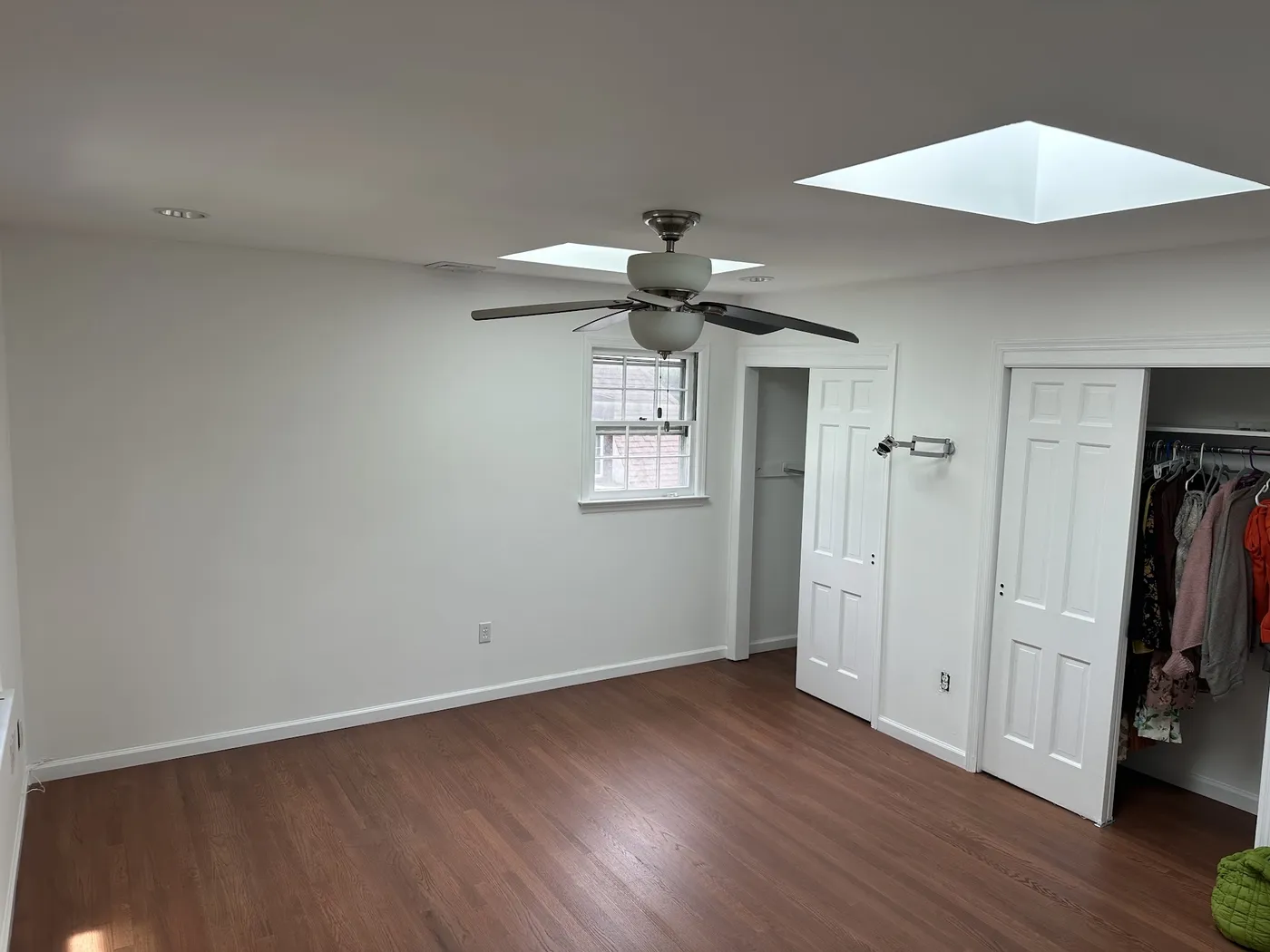
Storm Damage Rebuild by MG Builders, from a Customer's Google Review
The photo below was posted by an MG customer with the Google review quoted on this page, which describes a roof smashed by a tree followed by flooding. The review does not name a town, so no location is claimed.
What Homeowners Say in Their Google Reviews
Each excerpt below is copied exactly from a customer's Google review, shortened only where an ellipsis appears. The first describes storm damage to a roof; the others speak to how MG handles inspections, schedules and quotes. MG Builders is rated 4.8 across 90+ Google reviews. Read every review on Google.
“Our roof was smashed by a tree and then our entire 1st floor and basement flooded out less than a week later. Every estimate had us out of the house for a minimum of 6 months. Giovanni and his team got to work immediately and got us back home in less than 3 months just in time for back to school.”
“Our previous contractor was a fraud and left a big mess in our condo. Gio's team came in and fixed the mess and finished renovation. Gio also finished the leftover rough and final inspections.”
“MG Builders renovated one of our bedrooms and replaced our basement steps and windows. The quote we were given was fair and the work done was great! The team showed up every single day and worked efficiently through each day until all projects were completed.”
Roofing in Middlesex County: Frequently Asked Questions
How do I find good roofing contractors in Middlesex County, NJ?
Start with the paperwork. A home improvement contractor in New Jersey has a state registration number, and it belongs on any permit application. Ask each contractor to inspect the attic as well as the roof, to name the source of any leak, and to put the materials, flashing, ventilation and the handling of damaged sheathing in a written proposal. Reviews that describe how a contractor dealt with problems found mid-job are more useful than star counts alone.
Do I need a permit to replace my roof in Middlesex County?
Not for replacing only the roof covering on a detached one- or two-family house. N.J.A.C. 5:23-2.7 lists that work as ordinary maintenance, with no permit, notice or inspection. Work on rafters or other framing, new skylight or dormer openings, and rebuilding a storm-broken roof structure are outside that exemption and go through your town's construction office first.
Can a roof be repaired instead of replaced?
Often, when the damage is limited: a few blown-off shingles, one failed flashing detail or a small area of soft decking on an otherwise sound roof. Widespread curling or cracking, leaks in several places, soft spots across the slopes or a roof that has already been patched repeatedly usually point to replacement. An inspection of the attic helps settle it.
What should I do right after a tree falls on my roof?
Keep everyone out of the rooms beneath the damage, have the opening covered to stop more water, and photograph the roof, attic and wet areas inside. Then have the framing checked, because a broken rafter or joist makes the repair structural work that needs the town's construction office. The EPA advises drying water-damaged areas within 24 to 48 hours to prevent mold.
Does re-roofing involve lead-paint rules?
Only where the work disturbs painted surfaces, such as fascia, soffits or rake trim, in a home built before 1978. In that case, the EPA's Renovation, Repair and Painting Rule requires the paid contractor to be certified and to use lead-safe work practices. Ask any contractor for its EPA firm certification before that part of the job begins.
What affects the cost of a new roof?
The main factors are the size and pitch of the roof; how many layers come off; the roofing material chosen; how much sheathing turns out to be damaged; the number of chimneys, skylights, walls and valleys that need flashing; ventilation changes; access around the house; and any structural or interior repairs. MG Builders provides a free estimate after inspecting the roof and attic.
Does MG Builders do roofing in my Middlesex County town?
MG Builders serves all 25 Middlesex County towns listed on this page, including Edison, where its office is located, and Metuchen, Piscataway and Woodbridge. Call (732) 636-3000 to confirm availability for your address.
Middlesex County Towns We Serve
MG Builders serves these 25 Middlesex Countytowns. Permits come from the construction office that serves the property’s municipality.
- Edison, NJ
- Woodbridge, NJ
- Piscataway, NJ
- Old Bridge, NJ
- East Brunswick, NJ
- South Brunswick, NJ
- North Brunswick, NJ
- New Brunswick, NJ
- Perth Amboy, NJ
- Sayreville, NJ
- South Plainfield, NJ
- Metuchen, NJ
- Highland Park, NJ
- Carteret, NJ
- South Amboy, NJ
- South River, NJ
- Middlesex Borough, NJ
- Dunellen, NJ
- Spotswood, NJ
- Milltown, NJ
- Cranbury, NJ
- Helmetta, NJ
- Jamesburg, NJ
- Monroe Township, NJ
- Plainsboro, NJ
Roofing with MG Builders →
The full service overview.
Remodeling in Middlesex County →
Every service MG offers in the county.
Kitchen Remodeling in Middlesex County→
Permits, opening walls, older-home wiring and plumbing, and the questions to ask kitchen contractors in Middlesex County.
Bathroom Remodeling in Middlesex County→
Permits, ventilation, waterproofing and older-home questions for a bathroom remodel in Middlesex County.
Basement Finishing in Middlesex County→
Moisture, radon, permits and egress for finishing a basement in Middlesex County.
Home Additions in Middlesex County→
Zoning, sealed plans, permits and inspections for adding space to a Middlesex County home.
Need a Roof Repaired or Replaced in Middlesex County?
Call for a free estimate. If you would like to visit our Edison office, call ahead to confirm availability.
(732) 636-3000